Smart Contract Governance Layer
The Smart Contract Governance Layer maintains deterministic and secure execution of contracts while providing dynamic evolutionary capability.
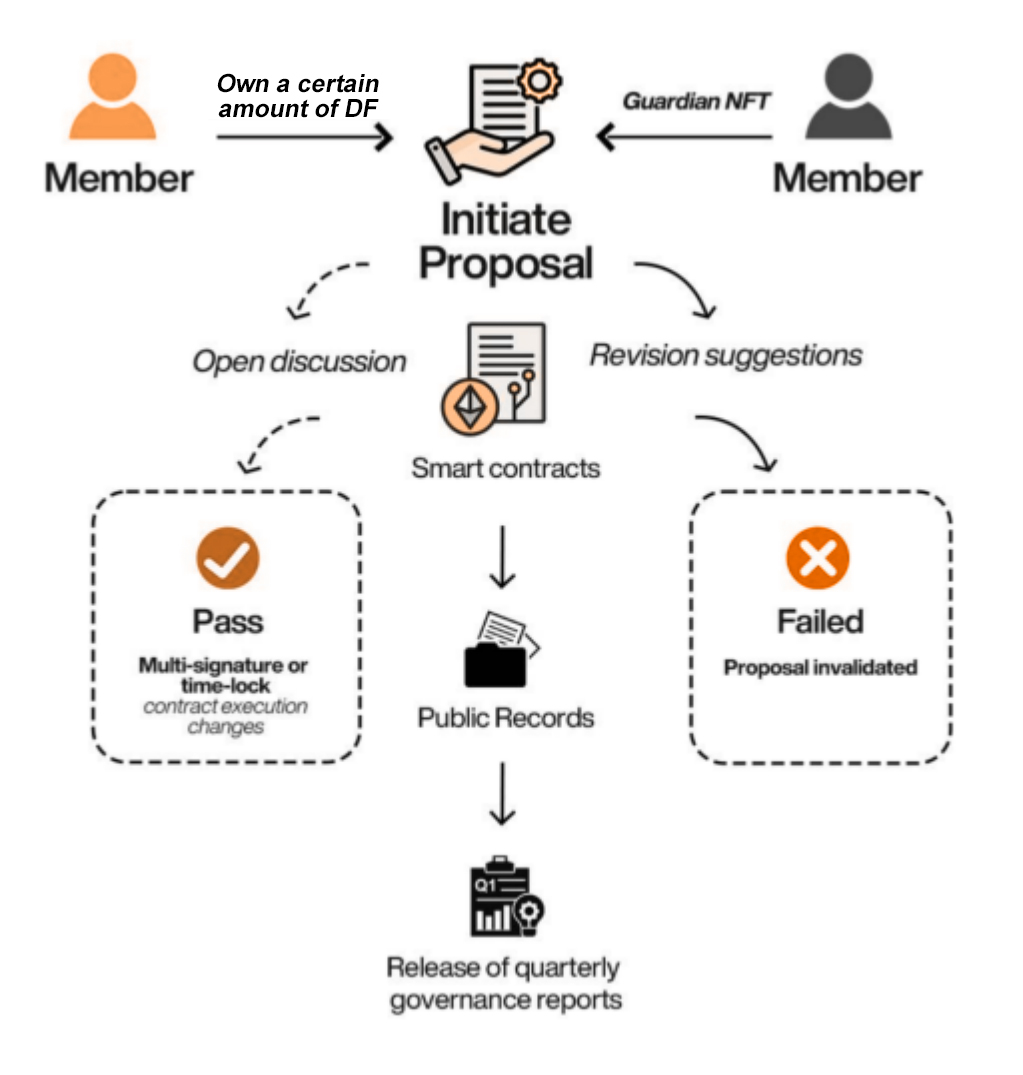
The smart contract governance layer is the top-level control system within the DF Protocol architecture. It is responsible for upgradable configuration of protocol parameters, permission governance over contract logic, security protection of critical processes, and the implementation of the future path toward decentralized governance.
1) Core Objectives
Provide a secure, transparent, and auditable workflow for parameter adjustments and contract upgrades;
Establish a permission-management mechanism based on multisignature and timelocks to prevent malicious control or emergency tampering;
Offer general governance interfaces for future DAO governance, parameter voting, and module authorization scenarios;
Ultimately enable a transition from protocol-controlled to community-driven decentralized governance.
2) Module Composition
The smart contract governance layer consists of the following submodules:
Governance Controller
Core governance master contract, responsible for receiving proposals and executing authorized actions
TimeLock Executor
All critical instructions take effect only after a delay window; provides minimum operation waiting period
Access Control Registry
Stores and maintains the permission-control state of each module (role separation)
Governable Parameters
Protocol parameter repository, allowing multisig-authorized modifications within permitted scope
3) Permission Control Mechanism (RBAC: Role-Based Access Control)
DF's governance framework adopts an RBAC model, with the initial roles defined as:
Core Admin: The sole governance controller during genesis, responsible for initial deployment and initial authority assignment;
Protocol Ops: Allowed to adjust non-critical parameters (e.g., compute-round duration, verification frequency);
Security Auditor: Authorized to trigger contract freeze or emergency pause;
DAO Delegate (Reserved): Future role for DAO proposals and on-chain voting rights.
Each role has its own permissioned address group, and any modification must pass through multisig and timelock procedures.
4) Timelock Execution Mechanism (TimeLock Executor)
All governance proposals involving core parameter changes or contract-logic upgrades must be scheduled and executed through the timelock contract:
Set a minimum delay time (e.g., 48 hours);
During the delay, the community may audit the proposal and signal objections;
Once the timelock expires and no objection is raised, the contract change is executed;
The timelock supports assigning different delay windows for different priority levels (critical / non-critical).
📌 Significance: Prevents the project team, attackers, or private-key-compromised parties from instantly initiating system-level modifications, and preserves a reaction window.
5) Governable Parameter Interface (Governable Parameters)
All non-fixed parameters in the protocol are centrally managed through the Governance Parameter Module (GPM).
Verification Frequency
Maximum number of tasks allowed per round, sampling ratio, reward precision
Node Policies
Identity registration window, blacklist configuration, reputation factors
Contract References
Addresses of task reception contracts, reward distribution routing
Security Whitelist
Reporting node domains, verification-server IP ranges
Governance contracts provide unified interfaces:
6) Contract Upgrade Mechanism
DF supports non-destructive upgrades of core logic contracts through a multisig + timelock mechanism:
Contracts are designed using a Proxy + Storage Separation architecture;
The upgrade process must follow these steps: Proposal → Multisig Approval → Timelock Queue → Execute
upgradeTo(newLogic);Upgrade records are fully traceable on-chain, with all version numbers, digests, and timestamps publicly published;
Any contract change must be logged via an on-chain UpgradeEvent and generate a corresponding digest.
7) DAO Reservation and Future Governance Extensions
To support long-term protocol evolution, the governance architecture reserves DAO module interfaces:
Proposal submitter:
submitProposal(bytes calldata payload);Voting module:
vote(uint256 proposalId, bool agree);Voting weight sources: mapped from node identities or long-term DF token holders;
DAO proposals will be able to call core-parameter and authorization pathways.
On-chain governance voting will be gradually introduced once the mainnet operates stably.
Last updated